


 Cart
Cart
 sales@molnova.com



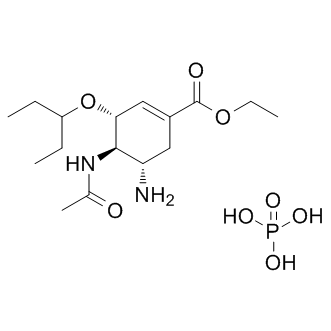
Oseltamivir phosphate
CAS No. 204255-11-8
Oseltamivir phosphate( GS-4104 )
Catalog No. M13177 CAS No. 204255-11-8
A competitive inhibitor of influenza neuraminidase that prevents new viral particles from being released.
Purity : >98% (HPLC)
 COA
Datasheet
HNMR
HPLC
MSDS
Handing Instructions
COA
Datasheet
HNMR
HPLC
MSDS
Handing Instructions
| Size | Price / USD | Stock | Quantity |
| 50MG | 32 | In Stock |


|
| 100MG | 45 | In Stock |
|
| 200MG | 56 | In Stock |
|
| 500MG | 76 | In Stock |
|
| 1G | Get Quote | In Stock |
|
Biological Information
-
Product NameOseltamivir phosphate
-
NoteResearch use only, not for human use.
-
Brief DescriptionA competitive inhibitor of influenza neuraminidase that prevents new viral particles from being released.
-
DescriptionA competitive inhibitor of influenza neuraminidase that prevents new viral particles from being released; an antiviral agent used to treat and prevent influenza A and influenza B.Influenza Approved(In Vitro):Oseltamivir phosphate (OP) is a prodrug that is readily absorbed from the gastrointestinal tract after oral administration and is extensively converted predominantly by hepatic esterases to Oseltamivir carboxylate (OC). Oseltamivir phosphate is a widely used anti-influenza sialidase inhibitor. The metabolic activity of CMA07 and CMT-U27 cell lines is significantly decreased with 305 μM Oseltamivir phosphate treatment (p=0.005 and p<0.0001 respectively) using One Way ANOVA testes. In contrast, no statistically significant alterations are observed with 0.305 μM (p=0.9781), 3.05 μM (p=0.7436) and 30.5 μM (p=0.9623) of Oseltamivir phosphate treatments when compare with control cells. Finally, to assess the effect of Oseltamivir phosphate on CMA07 and CMT-U27 programmed cell death, and given that 305 μM Oseltamivir phosphate treatment impaired cell metabolic activity, a programmed cell death measurement is performed with the TUNEL assay. Twenty-four hour Oseltamivir phosphate treatment, specifically at 305 μM, significantly increases CMA07 (p=0.001) and CMT-U27 (p=0.0002) DNA fragmentation, suggesting promotion of programmed cell death, when compare with lower Oseltamivir concentrations, or with PBS.(In Vivo):Oseltamivir phosphate-treated mice present significantly more inflammatory infiltrate in primary tumors (p=0.01). Ki-67 antigen and caspase-3 protein are used to assess CMT-U27 xenograft tumor cell proliferation and apoptosis respectively. Virtually no differences are found in Ki-67 and caspase 3 (p=0.2) expression between Oseltamivir-treated and non-treated mice.
-
In VitroOseltamivir phosphate (OP) is a prodrug that is readily absorbed from the gastrointestinal tract after oral administration and is extensively converted predominantly by hepatic esterases to Oseltamivir carboxylate (OC). Oseltamivir phosphate is a widely used anti-influenza sialidase inhibitor. The metabolic activity of CMA07 and CMT-U27 cell lines is significantly decreased with 305 μM Oseltamivir phosphate treatment (p=0.005 and p<0.0001 respectively) using One Way ANOVA testes. In contrast, no statistically significant alterations are observed with 0.305 μM (p=0.9781), 3.05 μM (p=0.7436) and 30.5 μM (p=0.9623) of Oseltamivir phosphate treatments when compare with control cells. Finally, to assess the effect of Oseltamivir phosphate on CMA07 and CMT-U27 programmed cell death, and given that 305 μM Oseltamivir phosphate treatment impaired cell metabolic activity, a programmed cell death measurement is performed with the TUNEL assay. Twenty-four hour Oseltamivir phosphate treatment, specifically at 305 μM, significantly increases CMA07 (p=0.001) and CMT-U27 (p=0.0002) DNA fragmentation, suggesting promotion of programmed cell death, when compare with lower Oseltamivir concentrations, or with PBS.
-
In VivoOseltamivir phosphate-treated mice present significantly more inflammatory infiltrate in primary tumors (p=0.01). Ki-67 antigen and caspase-3 protein are used to assess CMT-U27 xenograft tumor cell proliferation and apoptosis respectively. Virtually no differences are found in Ki-67 and caspase 3 (p=0.2) expression between Oseltamivir-treated and non-treated mice.
-
SynonymsGS-4104
-
PathwayMicrobiology/Virology
-
TargetInfluenza Virus
-
RecptorInfluenzaAandB
-
Research AreaInfection
-
IndicationInfluenza
Chemical Information
-
CAS Number204255-11-8
-
Formula Weight410.3997
-
Molecular FormulaC16H31N2O8P
-
Purity>98% (HPLC)
-
SolubilityDMSO: ≥ 150 mg/mL; H2O: 125 mg/mL
-
SMILESCCC(CC)O[C@@H]1C=C(C[C@@H]([C@H]1NC(=O)C)N)C(=O)OCC.OP(=O)(O)O
-
Chemical Name1-Cyclohexene-1-carboxylic acid, 4-(acetylamino)-5-amino-3-(1-ethylpropoxy)-, ethyl ester, (3R,4R,5S)-, phosphate (1:1)
Shipping & Storage Information
-
Storage(-20℃)
-
ShippingWith Ice Pack
-
Stability≥ 2 years
Reference
molnova catalog



related products
-
Nuezhenidic acid
Nuezhenidic acid is a natural product, posseses inhibitory activities against influenza A virus.
-
CEF3
CEF3 (SIIPSGPLK) corresponds to aa 13-21 of the influenza A virus M1 protein. The matrix (M1) protein of influenza A virus is a multifunctional protein that plays essential structural and functional roles in the virus life cycle.
-
Triazavirin
Triazavirin (Riamilovir sodium dihydrate) is a broad-spectrum antiviral agent targeting influenza viruses, lassa virus, TBEV and Ebola virus.
